
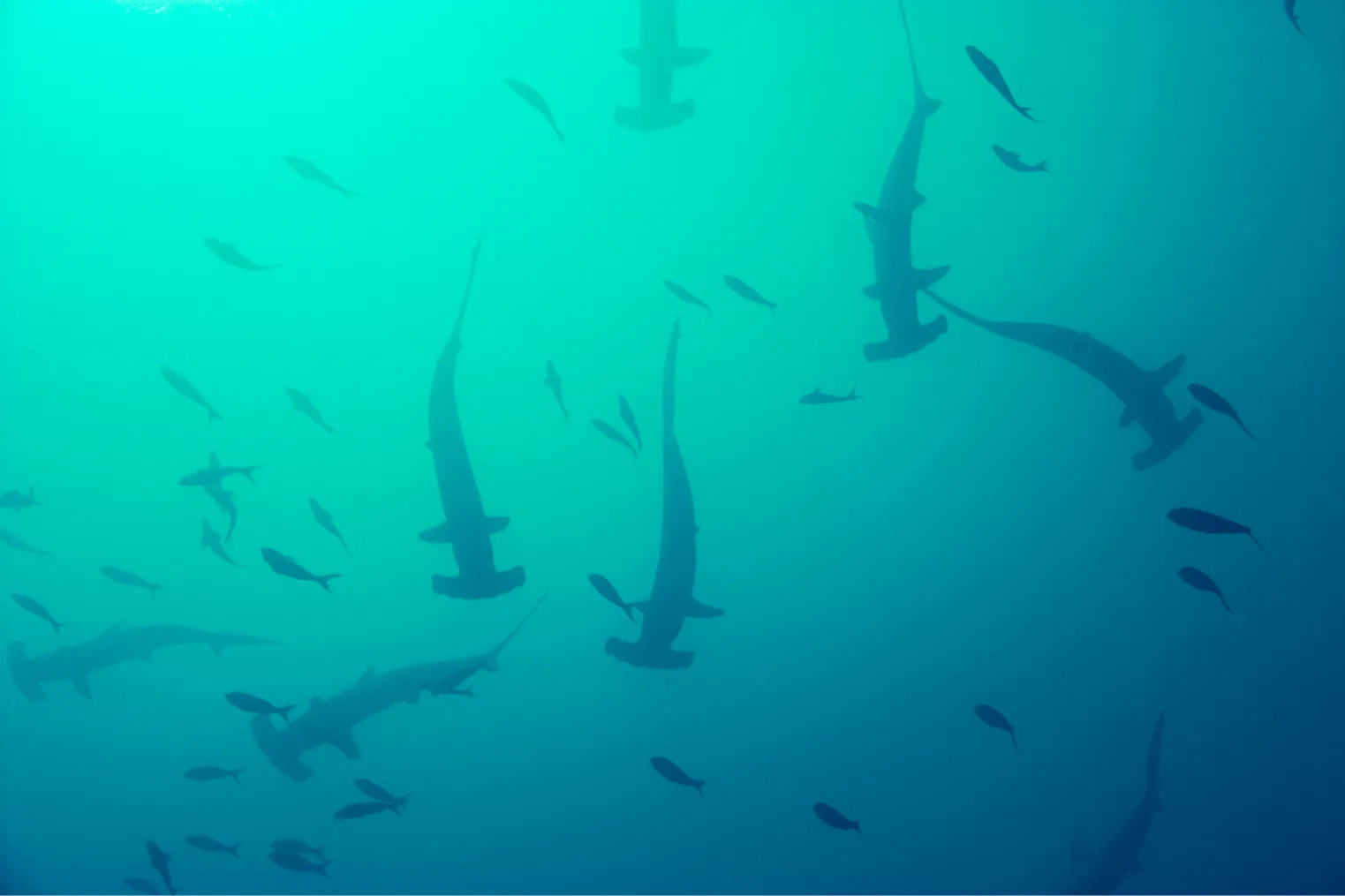
When you picture a shark hunting, think like a traveler moving from highway to side street to doorstep: you start with smell, tracking a faint chemical trail that drifts, splits, and swirls with the current, then you switch to the lateral line, feeling low thumps and pressure ripples like bass through water, and up close you rely on electroreception to pinpoint a hidden meal in the sand. Want to know which sense wins in murky water?
Key Takeaways
- Sharks use smell for long-range tracking, sampling odor plumes with bilateral nostrils to follow chemical gradients upcurrent.
- Scent plumes are turbulent and patchy, so sharks zigzag or loop, turning into stronger “hits” and widening search when signals fade.
- The lateral line detects low-frequency pressure waves and vibrations, mapping nearby flow, wakes, and movement to guide mid-range approach.
- Vision often dominates within 10–15 meters in clear water, but lateral line cues take over when visibility drops.
- Electroreception via Ampullae of Lorenzini pinpoints prey within about a meter by sensing tiny bioelectric fields, even under sand or murk.
How Sharks Hunt by Range (Far to Near)
While you might picture a shark spotting dinner with its eyes, the hunt usually starts far out in the blue with sound and scent doing the heavy lifting. From hundreds of meters off, you’re looking at hearing first, with smell confirming there’s something worth cruising toward.
Slide into mid range, and vision takes over for silhouettes, contrast, and quick flicks of motion, while the lateral line picks up pressure ripples like you’d feel a boat wake on your ankles.
Get within a few meters and that lateral line reads tighter swirls, helping the shark line up.
In the last meter, electroreception kicks in, the Ampullae of Lorenzini sensing tiny heartbeats, even in sand or murky water. Then comes a cautious test bite to confirm.
Around Oahu, Galapagos sharks are often described as confident, wide-ranging cruisers, which can make this far-to-near sensory sequence especially noticeable as they investigate.
How Shark Smell Finds Prey Far Away
You start with the shocker: a shark can pick up blood and other chemical cues at tiny levels, around one part per million, so a faint trace can pull it in from hundreds of meters away, like catching the smell of coffee down a long hotel hallway.
As water streams through the paired nostrils under its snout, millions of receptors sample the soup, and you can picture the shark taking quick “sniffs” as it swims to map a chemical gradient.
Around Oahu, spotting species like tiger sharks helps connect this long-range scent tracking to real animals visitors might encounter.
When the signal gets stronger on one side than the other, it corrects course and rides the odor plume upcurrent, so if you’re watching from a boat, look for that subtle zigzag that says it’s following the trail, not wandering.
Olfactory Sensitivity Thresholds
If the ocean seems empty at a distance, a shark’s nose quickly proves otherwise, because it can pick up blood at about one part per million, roughly a teaspoon in an average swimming pool, and in the right current that faint signal can travel hundreds of meters before it fades.
That olfactory sensitivity comes from paired nares leading to nasal sacs packed with olfactory lamellae, and they sample water without breathing.
Picture a coffee filter lined with chemoreceptors tuned to amino acids and fish oils, sometimes down to parts per 10 billion.
Despite the myth that sharks “smell fear,” they aren’t detecting fear itself but can pick up stress-related chemicals in the water, which helps explain sharks sense fear misconceptions.
For blood detection, calm, quiet conditions let odor plumes drift far, but turbulence breaks them up quickly.
Scent cues often start the long approach, and low-frequency hearing nudges the shark toward the action.
Following Chemical Gradients
That faint hint of blood isn’t a glowing trail so much as a broken, drifting “scent map” that a shark has to read in real time as it moves. You don’t follow a straight gradient; you ride a chemical plume, letting olfaction do the scouting. Water slips into nares, washes over lamellae lined with chemoreceptors, and every sniff gives you a clue. In turbulence the signal arrives in bursts, so plume-tracking means you zig-zag, turning into the strongest hits, then correcting when it fades. Those looping approaches can resemble circling behavior as the shark keeps reacquiring the plume and refining its line.
| Current feel | Scent cue | Next turn |
|---|---|---|
| Calm lane | steady tang | cruise upcurrent |
| Choppy eddies | sharp spikes | tack left, tack right |
| Faint wisps | nothing, then hints | slow, widen search |
Up close, vision, lateral line, and electroreception finish the job for you.
Still comparing Shark Senses Explained: Electroreception, Smell, And Lateral Line?
Ask for tour ideas, hotel suggestions, or a simple trip plan that combines both.
Trip Helper
How Scent Trails Spread and Break Up
Although a drop of blood or a pinch of fishy amino acids feels like it should draw a neat line through the sea, the ocean has other plans, carrying those chemicals along with currents while diffusion slowly smears them out, so the scent plume fades as it travels, sometimes down to traces sharks can still pick up at around 1 part per 1,000,000 for blood and 1 part per 10,000,000 for fish flesh.
You won’t find a smooth ribbon; water currents and turbulence chop the scent plume into brief filaments, so olfactory tracking means steering toward each whiff.
Chemical diffusion and shifting tides blur, then break the trail, and low signal-to-noise ratio from other odors makes the strategy simple, stay patient and sample often. Divers and snorkelers should remember that shark behavior in the water can include investigating unfamiliar scent cues without it being an immediate sign of aggression.
How the Shark Lateral Line Detects Vibration
Picture a shark cruising through murky water and “listening” with its skin, because the lateral line runs like a built-in motion radar from snout to tail, a tidy row of tiny pores feeding fluid-filled canals packed with hair-cell clusters called neuromasts. When water pressure changes or vibrations push canal fluid, those hair cells bend, fire quick electrical pulses, and you get a read on where the bump started, even below 200 Hz tailbeat thumps. In rough surf, expect shorter range; in calm bays, it can stretch to tens of meters. Oahu-based teams studying sharks often pair field tracking with close observation, and the lateral line is a key sense they consider when interpreting shark behavior in different habitats.
| Scene | What you’d feel |
|---|---|
| Kelp sway | slow, low hum |
| Fish kick | rhythmic taps |
| Rock edge | sudden dead zone |
| Your fin flick | tiny wake whisper |
Pause, glide slowly, and the lateral line message comes through.
What the Lateral Line “Maps” in Nearby Water
As the shark slides through dim water, its lateral line doesn’t just “hear” a vibration, it sketches a moving map of pressure shifts and water speed along its flanks, using a snout-to-tail line of pores and fluid-filled canals as a kind of close-range current tracker.
> A shark’s lateral line sketches a living map of pressure and flow, pores and canals tracking currents from snout to tail.
Inside, neuromasts bend like reeds, reading rumbles and the direction of water flow from swimmers or prey.
You compare timing and strength along the line, so the pattern tells you where an object sits, how big it is, and whether it’s closing or peeling away.
In near-field sensing range, within meters, the map becomes a track of pressure changes, and you ride a hydrodynamic wake like ripples behind a kayak.
Tip, move smoothly, sudden kicks broadcast you at night.
That’s why divers follow the No Touch, No Chase rule, keeping interactions calm so they don’t trigger unnecessary pressure-wave alarms in close range.
How Sharks Use Electroreception Up Close
Closing in on prey, a shark flips on a quieter, sharper sense, electroreception, and it works like a built-in compass for living batteries in the water.
When you’re within a meter, the snout pores around the jaw pick up tiny bioelectric fields from muscle twitches, even if the fish stays buried or still.
Your lateral line gets you close by reading ripples and pressure, then electroreception tightens prey localization to the last few centimeters, telling you which way to tilt, turn, and bite.
Signals run through the Ampullae of Lorenzini network and the brain stitches them into a clean directional cue.
Because humans aren’t typical prey, many encounters can involve test bites when visibility or context is confusing, rather than sustained hunting.
Because the effect fades fast with distance, you often bump or test-bite at the end, like tapping a door before you enter inside.
Ampullae of Lorenzini: The Shark’s Electric Sense
When the water turns murky and your eyes can’t help much, the ampullae of Lorenzini step in like a quiet, high-end detector built into a shark’s face. Clustered across the snout and head, these gel-filled sensory organs open as tiny dots, and pore canals run from each pore to cells that read voltage differences down to nanovolts per centimeter.
That’s electroreception in travel-size form, perfect for the last meter, where a hidden ray or fish under sand gives off faint signals from muscle twitches. Species tune the layout, and hammerheads, with a broad cephalofoil, pack pores wide for sharper “triangulation.” For orientation, you can also think of them as a compass upgrade, sensing weak fields from currents moving through Earth’s magnetism, supporting geomagnetic navigation. Hawaii’s emphasis on shark conservation highlights why understanding these senses matters for protecting species and their habitats.
How Sharks Combine Senses From Search to Bite
You can picture the hunt like a smart road trip: first you follow scent and sound from far off, like tracking a food market by the smell on the wind and the muffled thrum of crowds.
As you get closer, you switch to visual tracking and the lateral line’s feel for ripples and wakes, reading the water the way you’d read traffic flow and street signs to stay on course.
In places like Hawaii, cues can also help a predator distinguish between white-tip and black-tip reef sharks as they move and hunt in different ways.
In the last stretch, you lean on subtle flow changes and tiny electric signals to lock in the target, then you use a quick bump and a test bite to confirm it’s worth eating, because even sharks don’t want a bad meal.
Long-Range Scent And Sound
Tuning in to the ocean’s background noise, sharks start their search with two dependable long-range tools, sound and scent, because both travel far and stay readable even in murky, shifting water.
When you’re a shark, hearing picks up low-frequency sounds, 20 to 300 Hz, like a wounded fish’s thump or a boat’s rumble, and that beacon can pull you in from hundreds of meters, sometimes over a kilometer.
In Hawaii, tiger sharks are a common nearshore species visitors should know about, especially around murky water and river mouths where scent and sound cues can concentrate.
Next you lean on smell, or olfaction, sampling the current for amino-acid hints, even blood at one part per 1,000,000 or fish flesh at one part per 10 billion.
You don’t sprint blindly, you angle upstream, then track the chemical gradient while keeping the sound’s bearing, adjusting like you’re hiking toward a distant waterfall from afar.
Mid-Range Visual Tracking
As the distance shrinks and the target stops being a rumor in the current, a shark’s world clicks into focus, with vision taking the lead inside roughly 10 to 15 meters where shape, contrast, and quick movement finally read clearly, and in clean water that view can stretch to around 27 meters. You’re in the tracking zone, and the shark pairs vision with its lateral line to map wake and motion. Neuromasts feel thumps when light drops or water clarity turns to soup. Then, as it comes nearer, the ampullae of Lorenzini and electroreception help it line up. On an Oahu shark dive, that can translate to sharks making calm, curious close passes as they visually track and circle within this mid-range zone before deciding to move on.
| Moment | Your takeaway |
|---|---|
| 15 m | Vision grabs contrast |
| Murky | Lateral line + neuromasts guide |
| Clear | Longer sightlines, calmer choices |
| Near | Ampullae of Lorenzini, electroreception refine aim |
Close-Range Flow And Electricity
In the last few meters, the hunt shifts from general direction to pinpoint accuracy, and a shark starts stacking senses like a well-packed day bag. You ride the pressure map from the lateral line system, where fluid-filled canals and neuromasts along head and flank read each tail beat and swirl, even in murky water.
Then, inside about a meter, the ampullae of Lorenzini take over, their electroreceptors sampling bioelectric fields from gills and muscles, down to microvolts per centimeter, to aim at prey that’s still or buried. In places like Hawaii, ongoing shark research helps clarify how these sensory advantages translate into real hunting success and what that means for conservation.
- Follow flow first, it orients you.
- Trust electricity next, it fine-tunes the strike.
- At the bite, taste and touch confirm, so “test bites” can reject junk.
Keep your approach smooth, and you’ll miss less.
How Water Clarity Changes Which Sense Dominates
Often, water clarity decides which shark sense takes the lead, the way a city’s weather can change whether you navigate by skyline views or street sounds.
In clear blue water, you’ll see sharks start with long-range hearing and olfaction (smell), then switch to vision inside about 15 m, when contrast pops and body outlines read like signposts.
Farther out, electroreception can’t help much, so don’t expect lightning-bolt precision.
As water turns milky, that visual reach shrinks fast, and you should picture the shark leaning harder on low rumbles, scent trails, and the lateral line, which can feel pressure ripples and swimming beats from surprising distances.
Because behavior can shift around food cues used in tourism, responsible operators follow evidence-based practices to minimize conditioning and disturbance.
At the finish, the ampullae of Lorenzini guide close-in electroreception within a meter, like a final compass quick check.
Why Sharks “Test Bite”: and Sometimes Release
Picture a shark gliding in, giving one quick bite, then drifting away like a traveler taking a single sip before ordering the whole meal.
Up close, your silhouette and splash get cross-checked by the lateral line and the Ampullae of Lorenzini, but electricity and vibration can’t tell dinner from driftwood, so a probe bite settles it.
Close in, sharks verify splash and silhouette with lateral line and Lorenzini, yet vibration and voltage can’t ID food, so they bite-test.
In that snap, taste receptors and jaw chemoreceptors read texture and rich fats, and if it’s wrong, you’ll see a clean release.
Sometimes that first contact is influenced by a scent trail, which is different from feeding or chumming because it’s just odor moving through the water rather than intentional baiting.
- Sample first, commit later, it cuts injury risk.
- One test bite maps hardness, toxins, and payoff fast.
- Letting go keeps the shark moving and you alive.
If you’re in the water, stay calm, exit steadily, and treat any nip seriously, get medical help.
Frequently Asked Questions
What Animals Have Electroreception Besides Sharks?
You’ll find electroreception in rays and skates, many electric fish, including sturgeons, paddlefish, catfish, and monotremes, platypus electrolocation and echidna monotreme sensory. Some tadpoles show amphibian electroreception, and researchers explore invertebrate detection and possible bird electroreception.
Can Sharks Detect Electrical Signals From Boats or Underwater Cables?
Yes, you can, and you can: sharks detect nearby boat signals and cable interference when hull emissions or underwater wiring leak weak fields; even sonar leakage and powerlines effects can’t register beyond short range in water.
How Do Shark Senses Change as They Age or Grow Larger?
As you grow, you undergo sensory development: size related sensitivity rises as receptors expand. You’ll show ontogenetic shifts and maturation effects, moving from juvenile adaptations to age dependent foraging, smell and hearing extend, electroreception guides strikes.
Do Magnets or Shark Repellents Interfere With Their Electroreceptors?
Like a siren in the dark, magnets can confuse sharks’ electroreceptors at range: magnet effects and electromagnetic interference may boost repellent effectiveness. But battery powered deterrents and magnetized tags don’t cause electroreceptor damage; responses vary.
How Do Scientists Measure a Shark’s Sense of Smell in Experiments?
You measure a shark’s smell by running behavioral assays in flumes or Y-mazes, shaping odor plumes and concentration gradients, then estimating olfactory thresholds from orientation and scent discrimination; you confirm with anosmia tests and recordings.
Conclusion
Out on the reef, you can picture the hunt as a handoff: smell rides the current like a food truck aroma, the lateral line feels the thump of fins in low light, and electroreception nails the last inches, even over sand. If visibility drops, you’ll want to keep your hands calmly close and avoid splashing nearby. Remember, sharks don’t use one trick, they use the whole nine yards, then sometimes test-bite and move on too.


